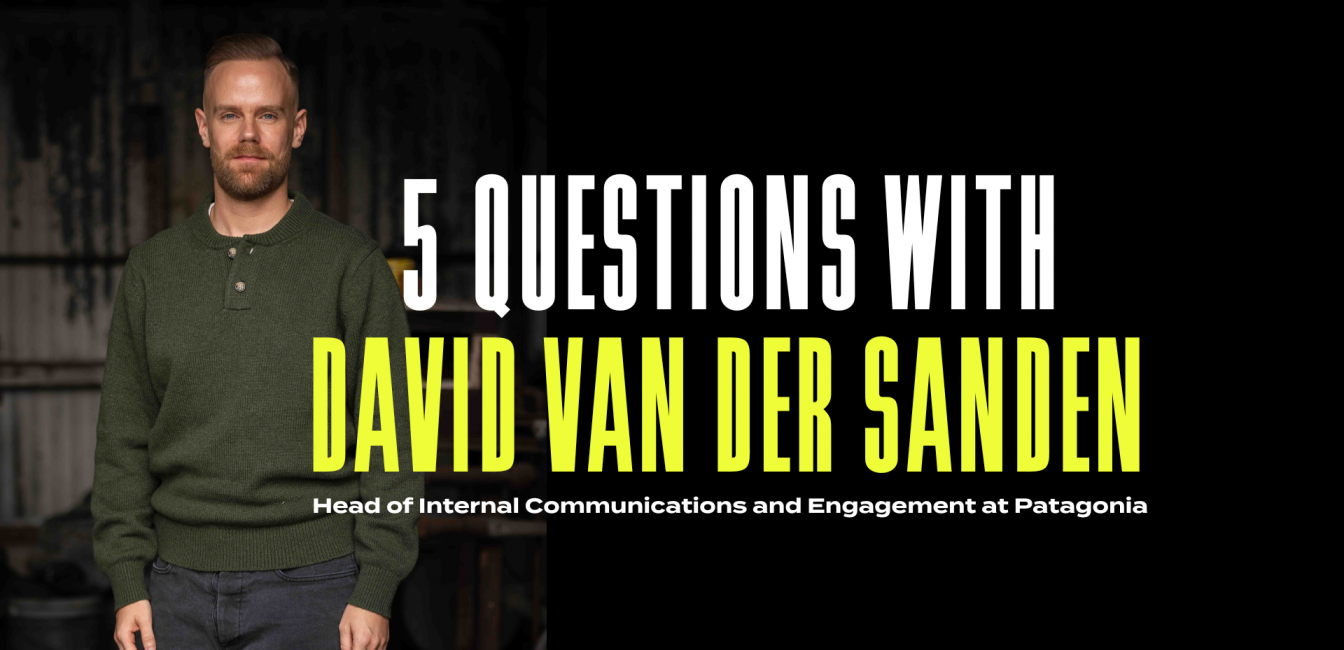
There are certain people you meet in passing who leave a lasting impression. I met David van der Sanden five years ago—three lives ago for him—when he was steering internal comms at Kraft Heinz. I had been invited to join a “Coffee Chat with Carlos” during the height of COVID, and while the session was with (now CEO) Carlos Abrams-Rivera, one of the sheer moments of joy came in the prep—where I got to banter, brainstorm, and laugh with David. He was disarming, funny, smart—and deeply human.
Today, David brings that same empathy and clarity to his work at Patagonia, and recently, he did something courageous: he spoke from the heart, in public, about what it feels like to be queer in America right now.
1. You shared that this year, you noticed the absence of Pride branding more than its presence. What did that quiet reveal to you about where we are right now as a culture?
It showed me how far we’ve drifted from the idea of collective responsibility. In many places, especially in the U.S., we’ve replaced community with individualism. We normalized disconnection. And that disconnection shows up everywhere: in policy, in workplaces, and yes, in brand behavior. The silence around Pride this year isn’t neutral, it’s a reflection of fear and retreat. And I think we should be asking why so many are suddenly more comfortable saying nothing.
2. You wrote, “Maybe I was part of the noise.” What did you mean by that—and how are you thinking differently about allyship and activism today?
For years, I was quick to critique hollow gestures, and sometimes rightfully so. But pointing out what’s performative isn’t enough. It’s too easy to call something out and walk away. Real allyship means staying in the room, especially when it’s uncomfortable. And most of all, it means not expecting the most marginalized people to carry the load. We keep asking the same communities to lead the fight for their own dignity. That’s not activism to me, it’s abandonment.
3. You call out that silence and retreat aren’t progress—they’re fear. What do you think is driving this fear, especially among brands and institutions?
Short term profit. Plain and simple. Fear of backlash, fear of losing customers, fear of controversy. But here’s my truth: strong brands aren’t built in safe moments. They’re built in the hard ones – by choosing to stand for something and standing by it. If your values evaporate the moment they’re tested, they were never real.
4. You mention a powerful moment at Patagonia’s Reno Distribution Center, where you felt what real support and belonging looks like. What happened—and what can other workplaces learn from it?
Years ago, before visiting a factory, a manager told me to “tone down” my identity. That comment said everything about what some workplaces expect: conformity over authenticity. But in our Reno DC, I saw the opposite. I saw queer people, not hiding, not minimizing, but shining. I saw what it looks like when a company doesn’t just tolerate difference but creates space for it to thrive. Don’t get me wrong, Patagonia isn’t perfect. But what I know is this: we show up and try. And that matters more than pretending to get it all right.

5. What’s something you’ve changed your mind about?
That visibility was enough. It’s not. Representation matters, but it doesn’t shift culture on its own. What creates real change is a willingness to overcome, and from the person who is brave enough to tell the full story. The good news? Culture can be shaped. I’ve seen it. I’ve been part of it. And that gives me hope. Because if it can be shaped by fear and silence, it can also be shaped by courage, optimism, and people who refuse to give up a good fight.

Would you like to learn more about David’s courageous story? Take a listen to this episode of The Courageous Podcast.